

Where AI fits in a security pipeline and where it doesn't
The hot path stays human-free. Expel ingests hundreds of billions of events a day, millions a minute, so putting a model inline is a non-starter on latency and cost; agents slot in further down the funnel where the work is bounded.
Triage and detection-writing are the near-term wins. Agents help cut false positives during triage, and detections that once took hours to write and ship to production now take minutes.
Lowering the floor and raising the ceiling
The floor dropped on what's worth automating. The four-minute chore nobody would spend three hours scripting now gets automated, because the model writes the script in moments.
The ceiling rose on what's worth attempting. Wescott built and shipped an iOS app with his daughter in a few hours knowing nothing about signal processing, the kind of project he'd never have started before.
Quality moves to the ends, not the middle
The QA pendulum is swinging back. As models write more of the system, every engineer's job becomes proving it does what they intended, and the code they own shifts toward validating the system rather than building it.
Judge the outcome, not the path. Migrating a detection pipeline, the team stopped caring whether the exact detections ran and checked only that efficacy held at the bottom of the funnel, proven by a test harness.
What drove AI adoption at Expel
Taking code away converted the skeptics. A one-month ban on hand-writing code, where engineers could still spec, review, and iterate but the agent did the writing, ended with even the doubters refusing to go back to the old way.
Adoption needs air cover, not mandates. The shift stuck because respected engineers presented it to their peers and leadership created space to experiment, not because anyone was ordered to use AI.
What this means for measurement and for engineers
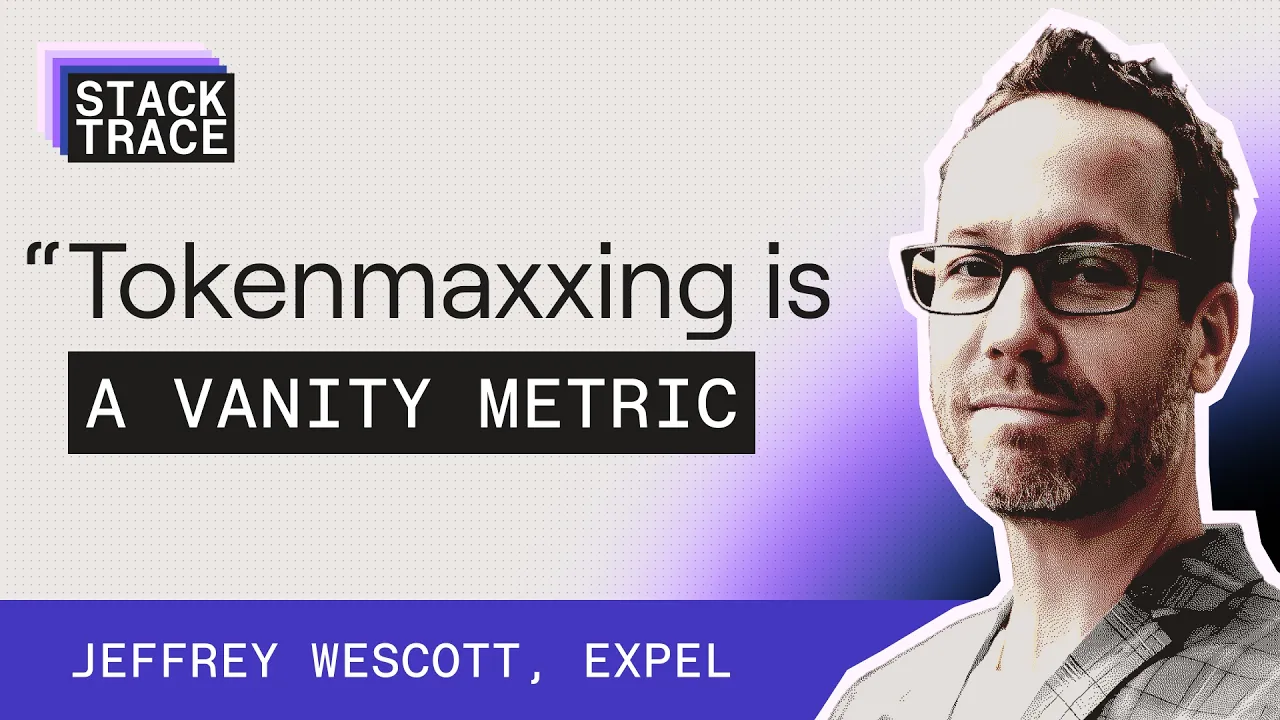
Measure impact, not tokens. Tokenmaxxing collapses the moment it becomes a target, and burning billions of tokens proves effort, not value; the business questions that mattered before AI are the ones that still matter.
For engineers, becoming AI-native is the job now. Specific tool fluency shifts too fast to bank on, so the durable advantage is the willingness to keep learning and treat these tools as the new baseline.

Jeffrey Wescott
VP of Engineering

Expel
Jeffrey Wescott, based in California, United States, is currently a VP of Engineering at Expel. Jeffrey Wescott brings experience from previous roles at Stellic, Lattice and Splunk. Jeffrey Wescott holds a 1991 - 1995 BCSE in Computer Science and Engineering @ Bucknell University. With a robust skill set that includes Leadership, Development, E Commerce, Distributed Systems, Git and more. Jeffrey Wescott has 3 emails and 3 mobile phone numbers on RocketReach.
Socials


timestamps
0:00 Intro: meet Jeffrey Wescott
3:53 What is Expel?
5:18 AI in cybersecurity: defending against bad actors at AI speed
10:05 AI's impact on software engineering
24:36 AI experiments at Expel
32:31 Why tokenmaxxing is "dumb"
36:00 Conclusion
Transcript
Stephen Poletto (0:00)
Good morning, Jeffrey. How are you?
Jeffrey Wescott (0:02)
Great, Stephen. How are you doing today?
Stephen Poletto (0:04)
Pretty good. Let's talk a little bit about who you are. You've played a lot of roles in the tech industry over the last 20 years. You've been a founder, a director of engineering at established, scaled companies like Splunk, you've worked at startups, you've led product, you've led platform and infrastructure teams, and now you're over at Expel. What brought you to Expel, and tell us a little bit about what you're working on now.
Jeffrey Wescott (0:36)
First of all, I'll acknowledge that what you said is true. Whenever I join a new company, I have to introduce myself, and it's always a little like, "Who even am I, and what do I even do?" As I've gotten older, I've come to accept that a big part of why my resume looks a little weird is because of ADHD. I think that's a superpower, and I don't think I'm the only neurodivergent person in the tech industry. What do you think?
Stephen Poletto (1:08)
I've met plenty of folks with neurodivergence in the tech industry. One of the benefits of attentional differences is that you end up with a really broad perspective as a byproduct of working across all these different domains and stages of companies. That perspective is pretty incredible, and it's needed right now, when AI is changing things so quickly. It's almost back to first principles and fundamentals. How do you reason through this transformational wave we're all going through? So to your point, it can be a superpower.
Jeffrey Wescott (1:46)
Yeah, it's been both for me, for sure. I've felt fortunate to do so many different things and meet so many interesting people, but I'm definitely not a typical person in the industry. I came to Expel primarily because I loved the people. I'd had two false starts between my previous role at Lattice and Expel, where I said, "I'm going to optimize for different things," maybe outcome potential, or other things. And in my gut I had this feeling of, "Is this the right thing? I'm just going to lean into it and try it out." The first of those was a place that wasn't a strong culture fit; I'm not going to talk about it, and it's not even on my LinkedIn. The second was a Series A startup, which I loved. Loved the people, loved the mission, and I was actually having a lot of fun. But about eight months in, having worked 70-to-80-hour weeks the entire time, I realized my gut was right: Series A is probably not the right stage for me with two young kids at home.
So I took the summer off, stepped away, stopped looking, and just tried to be for a minute. Then Expel reached out, and I really hit it off with the founders and the leadership team. It felt like a place that believes their success is tied to the people at the company. If you look through my career, the places where I've stayed the longest tend to be those kinds of places. You could call it "people first," or whatever. What that means in the AI world is maybe an interesting discussion point, but fundamentally, when I love the people I work with and enjoy the nature of the work, time disappears for me and I'm having a blast. So I feel really fortunate to be at Expel.
I'm the VP of Engineering here. Our platform is managed detection and response in cybersecurity. The easiest way to think about it for folks who aren't familiar: there are all these things happening across SaaS platforms, devices, and endpoints, and it's just a bunch of noise. We try to reduce that to the signal that needs to be paid attention to by someone's security operations team. A lot of people completely outsource their security operations to us; for others it's a hybrid mode where we augment their team. Fundamentally, we deliver security outcomes by finding the signal in the noise, which is a very AI-shaped problem. So we're in a pretty good position. Like the entire tech industry, there are significant headwinds, disruption, and change right now, so it's complex and there's a lot of pressure, but I'm having fun.
Stephen Poletto (4:46)
Yeah, well, I'm sure you've seen the recent headlines about Mythos and the new threat vectors that all these AI tools can generate. Security tech is as important as ever, more important than ever, to help defend against bad actors who now have even more powerful tools to infiltrate systems. As you look at the AI dynamic as both a tailwind and a headwind for Expel, talk me through some of the dynamics you're facing as you build the product: how AI is incorporated into your product and makes it better, and also some of the headwinds you face with AI development on the scene.
Jeffrey Wescott (5:35)
Yeah, this is a really good question. I'll tackle it from both sides. If you think about the bad actors, the people trying to infiltrate systems or do harm, we like to think of ourselves at Expel as the good guys who are actually trying to prevent bad things from happening. What AI does for the bad actors is accelerate everything. They can launch a bunch of things in parallel. They don't have to open their hex editors anymore to find problems in software. They can just throw an agent at it and say, "Tell me all the vulnerabilities here," as we saw with the announcement of Mythos. But people were doing that even before Mythos. So now companies are being attacked at AI speed. And you'd think the answer is, "We'll just put AI on defense and meet them at AI speed." But what people don't realize is that at Expel, for example, we ingest hundreds of billions of events every day, millions per minute. We can't put an LLM in that path. The latency is—
Stephen Poletto (6:45)
Way too high. The latency is way too high.
Jeffrey Wescott (6:48)
And even if some tokens are subsidized now, it wouldn't be reasonable. You may as well have a human trying to read every event. So the question becomes: where in our data pipeline, this noise-to-signal funnel, do you slot in the agents to do the parts they can do well? And there are other problems shaped like this; it's not just security problems. We're in the midst of sorting that out.
One interesting thing about Expel historically is that as we've increased the number of customers, our SOC, the humans who actually investigate all the incidents and alerts we surface, has not grown by anywhere near as much. You might ask, "Are you guys cheapskates?" The reason is that we've automated everything. Even pre-LLM, our entire system was powered by ML models. At every stage of the funnel we have custom-trained models doing all kinds of automation, plus workflow automation behind the scenes. So the question is: for those humans we believe will always need to be there, especially for enterprise customers, how can we offload some of the more mechanical work that agents are really good at? Triage is a good example. We've reduced all the noise down to this much signal, but even within that signal a lot is still going to be benign. You can't really have false negatives. False positives are okay, false negatives are not. And triage can really help us reduce the false positives. That's what we're playing with most aggressively right now.
The other interesting place for AI to plug in is more behind the scenes. Instead of inspecting alerts as they come in, we write detections. A detection is like, "There's an event shaped like this, here's what the fields look like, here's what the message looks like." Historically we've written those by hand much of the time. With LLMs, we can look at a whole set of events and say, "These events were not benign. Write us a detection that would prevent these in the future." LLMs are really good at finding those patterns in the data, so we can generate new detections. Where it used to take us a few hours to write and deploy a new detection in production, we can now get that down to minutes, which is really exciting.
And then the one I'm sure we'll get into in more detail is the software engineering discipline itself. There are the detections we write, all the security-shaped activities we do with very technical people in our SOC and detection-engineering functions, and then there's the platform, basically these giant data pipelines and orchestration systems, where we can now move at AI speed building things out.
One way I've been framing this for people, and I don't know if it resonates with you, Stephen, since you talk to a lot of people, is the notion of lowering the floor and raising the ceiling. There's always a set of things where I think, "This takes me four minutes every day, but it would take me three and a half hours to build a script to automate it, so I'm just not going to do it." Well, now you are going to do it. The number of things you're willing to automate has increased because the floor has lowered. The AI can build these scripts that would take us an annoying amount of time to write, but it can write them very quickly. So we're automating more of the things that are in the way of our velocity.
Then there's the raising-the-ceiling piece. I'll give an example that's not from work. My daughter has synesthesia, specifically chromesthesia, a subset where when she hears sound or music, she sees color. She said, "Daddy, I want to make a video to show my friends what this is like." And I said, "No, you want to make an app." So we coded up an app in a few hours. It's in the iOS App Store, it's free, and you can play with it. I know nothing about signal processing, and I know nothing about visualization with GL or anything like that, but because I have AI that does, and I know enough about software, I could actually build this app with her. The ceiling has been raised for me, even though I'm not really a professional software engineer at this point. I'll attempt things I never would have attempted before, and I think a lot of our engineers are feeling that too. It's like, "Oh, that's too hard," or "That's impossible," and now it's, "Well, is it actually?" How much we're willing to cede that expertise to the machines is the ever-growing question, but the floor is being lowered, the ceiling is being raised, and velocity is increasing. The thing I'm less sure about is what that means for the quality and maintainability of the platform long term. I don't think anybody knows, and anybody who says they do, well, we're too early in the innings to know that.
Stephen Poletto (12:26)
Yeah, the lowering-the-floor thing. There's a lot of discussion about AI taking away software jobs, but I've always felt there's a constraint on how much software can be produced relative to how much the world needs. There are all these niche markets and domains that software would benefit, but the cost of producing a solution was always so high that it wouldn't clear a hurdle rate; it wasn't worth the effort. Now, with that effort reduced and the floor lowering, there's more incentive to go after this long tail of software projects that otherwise would have been unfundable, because you needed to hire an engineer and put in so many hours. So I think there's actually an opportunity for net creation of more work if we look at it through that lens.
On raising the ceiling: the dialogue I often hear is that it's empowering people to step beyond their subject-matter expertise. You have engineers being pseudo-designers, product managers shipping prototype code, everyone stepping into each other's arena because they're bolstered by the confidence these models give them. And there are unknowns around the second-order effects of that, like maintainability and what happens when things go wrong. I'm sure you think about this in the security world, because security is uniquely high-stakes for shipping AI code and for customer trust. Security is a difficult arena because everything is good until something goes horribly wrong. The absence of things going horribly wrong is the success. So I'd love to hear how you're thinking about AI in the software engineering discipline at Expel, specifically around the benefits of velocity gains versus the risks of quality issues and the customer trust that could be degraded, and the kind of guardrails you're trying to invest in.
Jeffrey Wescott (14:50)
"Guardrails" is exactly the word I'll take as the jumping-off point. Let's assume the models continue to develop apace and keep getting better, taking over more and more of "we're going to build this solution." The hard part then becomes: I didn't write it, so how confident am I that it's actually doing what I wanted, without reviewing every line of code, which, at the scale AI generates code, doesn't seem realistic?
My best guess at where we're headed: I've been in the industry for 30-plus years, in leadership for 20-plus, and building stuff for 40-plus, so I've watched the pendulum swing. Back in pre-internet days, when shipping packaged software was really expensive, quality assurance was a big, primary discipline. As we moved toward continuous deployment on the internet, it became "engineers test their own code," and we shrank quality engineering into more of an enabling team that teaches people how to think about quality and does some test automation. I actually think the pendulum is going to swing back, not necessarily to the same people who called themselves quality engineers, but I think every engineer's role is going to become, "How can I prove to myself that this thing is doing what I want it to do?" The code engineers write, or are more involved in, will be the code that validates the system, while the AIs build the system itself.
There's some really wild thinking on this. I think you and I spoke recently about StrongDM and the "software factory." They have some wild ideas people are exploring. One of them is the digital twin. If you're a company that does a lot with Microsoft Entra, Active Directory, or Okta, you can't hammer your production Okta, you'll get rate-limited, so they built a digital twin that fully mocks Okta. Is that realistic? Who maintains that thing? So I have more questions than answers. But I do think the shift for engineering expertise is going to be, "I actually know what this thing is supposed to do, so I'm going to coerce the model into doing it." I'm going to spend a lot of time spec'ing exactly what I want and iterating ahead of time, which is maybe shifting us away from agile and back toward waterfall. It's just that the waterfall is faster. And then it's, "Now that the thing's built, or while it's being built, how am I going to validate that it's really doing what I want?"
Where I think all the danger is: some people say, "I'll just write it all over here, and then have the AI write all the tests and validation." Sure, everything's green. But is it, though? I don't know. So there's something there we haven't figured out yet, or at least I haven't. If you have, please reach out and tell me.
Stephen Poletto (18:22)
I mean, the work shifting to the ends instead of the middle is what I'm seeing across a number of the companies we work with. Some of the more innovative development shops, what I'll call AI-native or AI-led, are investing in things like spinning up an ephemeral environment on every pull request: they patch that PR, create an environment where you can actually click around and play with the change to validate functional correctness, maybe run some automated tests there. Back when I was a tech lead, the first thing I'd do with a pull request was patch the change into my dev environment and look for functional correctness before I'd even bother reviewing the code. Why spend all that time reviewing if there are obvious bugs I could just QA back to the engineer? There are now organizations starting to ask, "How do we stop code-reviewing everything?" Some are evolving their SOC 2 controls and compliance controls to say human review isn't required on every change. So that's very much the world we're moving toward: what's the new validation infrastructure that gives you confidence without having to read every single line of code? What QA looks like in an AI-native world is a really interesting question right now.
Jeffrey Wescott (19:50)
Yeah. And I don't know what you're hearing from other leaders, but as you said, we're moving to a world where we're not going to review every line of code. I'll just say it: the most senior engineers at Expel are very, very uncomfortable letting things go to production without a thorough human review. So we're still in that mode, especially as a security company. We cannot miss. False negatives are not okay.
Stephen Poletto (20:20)
Yeah.
Jeffrey Wescott (20:21)
It's existential for us. We can't have downtime.
Stephen Poletto (20:26)
No, that makes sense. Let some of the product teams that move fast and break things pave the road, and you can follow. You want to use your innovation tokens in a sensible way for your business, and sometimes you want to follow other people after the patterns get established, because the stakes are too high for Expel.
Jeffrey Wescott (20:48)
Yeah. One of the guys I've worked with a bunch of times, this is the fourth time I've recruited him to a company, doesn't come from a security background, but he's working on some of our data pipelines. We have all these detections that run in these pipelines, and I said, "If we build this new pipeline, we're going to have to figure out how to migrate all these old detections." He just said, "Why?" And I said, "What do you mean, why? We have to detect all the things." He said, "But all you really care about is that the efficacy is greater than or equal to what it is at the bottom of the funnel. You don't care if the exact detections run." And I said, "Oh yeah, that's correct." It took somebody from outside the world to point that out, and he's thinking about it the right way: all we really care about is the outcome. Let's not worry about what's happening in the middle; let's make sure we deliver the customer outcome that's wanted. So in this big project they're doing, they've decomposed all these detections and are figuring out how to migrate them to the new system. It's not one-to-one at all, but they have a test harness that proves the efficacy is greater than or equal to before. I think that's the world we're moving toward: how can we get confidence? Some of the best, most forward-thinking engineers are already there, even if there aren't playbooks yet for the rest of us to adopt.
So you're right that the CRUD apps and simpler things will pave some roads. How applicable they are to what Expel does, basically massive automation, data flow, and orchestration, we may not be able to borrow much, so we have to think about it ourselves a bit. But so far we're still in the mode where things don't go to production without a human review, and as a result we're noticing a pile-up of pull requests. I think all teams are feeling that.
Stephen Poletto (22:50)
As AI writes more code, it creates more of a bottleneck on code review. Let's talk about that. PR volume is up; two-week sprints feel like a thing of the past. It was all agile two or three years ago. That was the industry standard, two-week sprints. But now they feel irrelevant. Spending an hour in a backlog-refinement meeting doesn't feel like a good use of time. There's a generation of engineering managers who were trained on a certain set of processes that feel increasingly irrelevant. I'm curious what kinds of experiments you're running, and whether you're finding new processes, or vignettes of engineers doing interesting things, that feel more matched to this new era of development.
Jeffrey Wescott (23:43)
I love this question. I'll start with one experiment I led. When I got here, a lot of people, especially outside of EPD, were saying, "How can we get higher velocity?" I came into the company with people wanting that. When is it not wanted? In my interview process I was asking, "How much AI are you using?" This was back in the summer of 2025, before that watershed moment in December, but since I was off that summer I was already learning the capabilities.
Stephen Poletto (24:25)
You were becoming AI-pilled because you had time to tinker.
Jeffrey Wescott (24:29)
Right. So I said, "There's low-hanging-fruit velocity we can claim here." But when I joined, I noticed a wide range. Some people were at the vanguard, "I use AI every day, and here's what that looks like," and some were very skeptical. So I took a smattering of the most senior people across that spectrum and formed a temporary, ephemeral group I called the AI Coding Crew. In my skip-levels I'd talk to ICs and say, "Hey, do you want to be part of this experiment?" Some said, "Sure, but I want to warn you, I think this is all BS, it's not going to work." And I said, "Great, I want that represented here." So we pulled in fewer than 10 folks, about eight, mostly staff-to-principal-level people, for a one-month experiment.
I said, "For the next month, I want you to stop writing code." They said, "What?" I said, "I don't want you to stop shipping code. I want you to let the agent write the code. You can review it, spec it, iterate." Being engineers, they immediately asked, "What if there's a one-character change in one file?" I said, "Guys, it's the spirit of the message, not the letter. Don't burn the tokens for that, but you get the idea. Really resist the urge. We'll regroup in two weeks and talk about how it went, and if you need air cover with your manager, let me know, I'll talk to them."
Two weeks later we met, and I expected mixed results. Instead, everybody was like, "Wow, I had no idea how far these things have come." So I asked, "What did we learn? What did you do to make it work?" People shared their approaches.
Stephen Poletto (26:27)
When was this timing?
Jeffrey Wescott (26:29)
This was right around December.
Stephen Poletto (26:40)
So, after 4.6 or 4.5?
Jeffrey Wescott (26:42)
Right. One guy said, "I wanted to see if I could be faster than the AI on a well-worn path I've gone down a bunch of times, a fairly mechanical thing, so I raced the AI. Not even close. The AI destroyed me, and it wasn't even that complicated. Now I just spend all my time getting clear on what I'm building, with the AI's help." There's a lot of iteration on the spec, the plan, whatever it is. There are all kinds of frameworks people have come up with. A popular one internally at Expel is GSD. It's more of a methodology than a piece of technology, though there are some skills and things you can plug into the agent.
Stephen Poletto (27:32)
There's Spec Kit, and—
Jeffrey Wescott (27:34)
Spec Kit, yeah. Some are heavier-weight, some lighter-weight. But a general theme emerged in those first two weeks: I have to spend more time getting clear on what I'm building. What's the gap between the requirements I know and where the rubber meets the road? I'm spending most of my time there, and the more time I spend there, the better the agent does. That was a general learning.
Then I said, "Let's keep going for another two weeks." We regrouped, and I said, "What if I told you you couldn't use Claude Code anymore?" And for the record, everybody was using Claude Code. People said, "Out of my cold, dead hands. No way would I go back to the old way," including the skeptics. And I said, "Great. At the next all-hands, can you all put some slides together and present?" Because me standing up in front of all of engineering saying "You have to use AI" isn't going to work. But if you all, the respected people, stand up and say "We just did this," it'll go over much better. That really kicked off AI adoption within engineering at Expel. It was a huge success. One of the EMs reached out right away: "What exactly did you do for this experiment? I want to do the same thing on my team." And I said, "I didn't do a whole lot, man."
Stephen Poletto (28:59)
Yeah, air cover. You talk about the watershed moment in December, November, December, when 4 or 5 came out. I think one of the reasons it was such a watershed moment is that you had these busy executive people and managers who went into the holidays and actually had time to tinker. You say you didn't do much, but creating space for people to experiment and give it a fresh look is actually really important. If you're staring down a delivery deadline, are you going to do something uncertain that requires new learning and adds risk to the timeline, or do it the way you know how? You'll do it the way you know how. So that mandate and that space is really powerful. Whether it's a hackathon, a working group like you did, or something else, you have to give people space to try, fail, and learn in order to embrace a new way of doing things.
Jeffrey Wescott (29:57)
Yeah, you said hackathon. That's the other thing we did. We have them quarterly at Expel; they're called Expelloratory Time. They happen every quarter. This last one, we changed the format a little: leading into the hackathon, the AI Coding Crew ran enablement sessions on how to use Claude Code and get people up and running, so people had a lot of space and freedom in those three days to really go for it. Not only was it the best hackathon we've ever had, but the scope of what people were able to do in three days dramatically increased, and some of those things have made their way into production.
So at the last engineering-managers all-hands, I said, "Look, I know the dogma and the religion has been agile, quarterly planning, sprints, retros, and I don't know if that's right anymore. I actually don't know what is right, and if you're looking to me to figure that out, you're going to be disappointed, because I honestly don't know what to do. But I want you all to experiment and share with each other what is and isn't working." We're at the beginning stages of that. What I don't have for you is a report saying "this leaf-node team did this thing and it's working really well." But what I can tell you, especially because we have some of the data in Span, is that you can see which teams are more AI-native, and you can see the impact on velocity and quality. What we're noticing in our data is that velocity is way higher, and bugs are higher too, but not by the same amount. More code, more bugs, but bugs are increasing at a slower rate than the number of things we're shipping, which is not what I expected, honestly.
Stephen Poletto (31:53)
And if you can fix the bugs quickly too, a slightly elevated bug rate is a good trade-off to make.
Jeffrey Wescott (31:58)
As long as it's not people. One experiment people are running, and I don't know how well it's working, is having Claude in GitHub: it looks at the Jira bug when it's filed, tries to resolve it, tests it, and submits a PR. But that just generates more PRs, so people say, "This isn't right." And I'm like, "Well, is it? If the bug gets fixed..." I don't know, guys.
Stephen Poletto (32:21)
Awesome. Thanks for sharing some stories. I think we're coming up on time, but I have one more question, and it's very timely, because it's out in the ether right now: tokenmaxxing. It seems like something a lot of engineering leaders have been using to incentivize and promote adoption and usage. Any hot takes on the tokenmaxxing theme?
Jeffrey Wescott (32:43)
Tokenmaxxing is dumb. I'm sure everybody's familiar with Goodhart's Law. If you're not: I forget exactly how he phrased it, but it's something like, "Any measure that becomes a target ceases to be a good measure." Tools like Span wrestle with this: how can we present metrics that hint at what's going on without people wanting to game them? Tokenmaxxing is the most gameable thing ever. You want me to burn tokens? I can burn tokens. I've heard of someone at OpenAI burning billions of tokens a day, and I'm like, what could you possibly be doing? The value-to-token-burn ratio is what I think is actually important. What I'll share at Expel is that we believe driving people along the maturity journey toward AI-native is more important than clamping down on token spend right now. That's especially true because we're in this narrow window where some tokens are still subsidized with these premium plans. I think all of that is going away. It's going to get more expensive, and then the open-source models will catch up, and it'll swing back, and I think it'll equalize over time. I'm optimistic about that.
Stephen Poletto (34:08)
A question I have is: do you always need the frontier model for the task at hand, or could you use a model that's a year old, cheap, and good enough? Model selection and cost are going to become a new game we have to capital-allocate for.
Jeffrey Wescott (34:23)
But when you think about all the processes we put in place on the people side, promotions, spot bonuses, all of it, the word everybody uses is "impact." That's what everybody wants to see: How did you affect the business? Did you save the business money? Did you deliver something customers are willing to pay for? Did you resolve a long-standing pain point across the org that saved a bunch of developer time? Anybody on the people side really cares about that, and it's hard to tell someone, "I get it, you did all this stuff that was really hard and it proves your technical prowess, but from the business perspective it kind of didn't matter." That's hard to hear. "Good job, you burned all these tokens, but why, and who cares?" So I think tokenmaxxing is going to be a fad that has a big burst and then dies quickly, especially once those subsidized tokens get turned off. It's just not the right metric. The metrics haven't changed. What you want to do in a company hasn't changed. You want to make your customers happy, totally.
Stephen Poletto (35:38)
But at the same time, what I hear from you is that you're not trying to prematurely optimize cost either, because you want people experimenting and learning the new game on the field, and the cost-management phase can come in a subsequent chapter. I'm sure it will for a lot of us, but right now the focus isn't there. It's on value delivery and getting people to embrace this new way of working.
Jeffrey Wescott (35:59)
Yeah, I'll just put a fine point on what you just said: if I were an IC right now, all I'd be doing is upskilling. As an engineer, the only thing that matters right now is whether you're getting to a place where you can become AI-native from a career perspective. If you're toward the end of your career and ready to call it in a year or two, maybe not. But for the rest of us, I think it's the only thing that matters. It's probably true for people-leaders too; it just looks a little different. These are superpowers we now have. The people who are going to be most valuable in the future version of the industry are the ones who've learned how to use these tools to their advantage. And that thing you said earlier about people veering into each other's arena, is that a problem, or is it because these roles are... I don't know. We'll see.
Stephen Poletto (36:45)
Cool. We'll leave it there. Jeffrey, thanks so much for the time. This was a really fun conversation.
Jeffrey Wescott (36:54)
Super fun, man. Have a great rest of your day.
Stephen Poletto (36:58)
And you too. Thanks for the time.


Let's talk about where your AI program is.


platform
Resources
© 2026 Attuned Inc.


