

Where productivity really stands
The speed-up is real, but we're nowhere near the ceiling. Code generation is dramatically faster, yet Pierpaolo thinks cumulative productivity is still only trending up, not close to where it'll land in aggregate.
The 10x engineer finally exists, with a catch. The ones who feel 10x share three traits: they engineer their workflows, they hold several parallel threads in their head (around five on screen at once), and they work in parts of the codebase that can safely move fast.
The new bottleneck is coordination, not code
Easy tooling creates a fragmentation tax. When anyone can spin up their own internal tool, teams end up with X, X-prime, and X-double-prime solving the same problem, and reconciling them accrues negative value, confusion instead of alignment.
Planning is the underrated skill of the moment. Faster individual output plus more parallel threads produces a more fragmented product experience; the company-level vision and the touch points that hold the outcome together are what's going wrong.
What stays human (and what doesn't)
Code review is shifting to the machines faster than expected. Pierpaolo is turning around on review as a human job, he's seeing automated comments better than his own, and even a heavily regulated company is working with regulators to certify automated reviews.
Three skills resist commoditization: debugging, business context, and collaboration. They sit on the outer edge of the skill sphere; writing code is the middle, and the middle is what's getting commoditized.
The case for managers
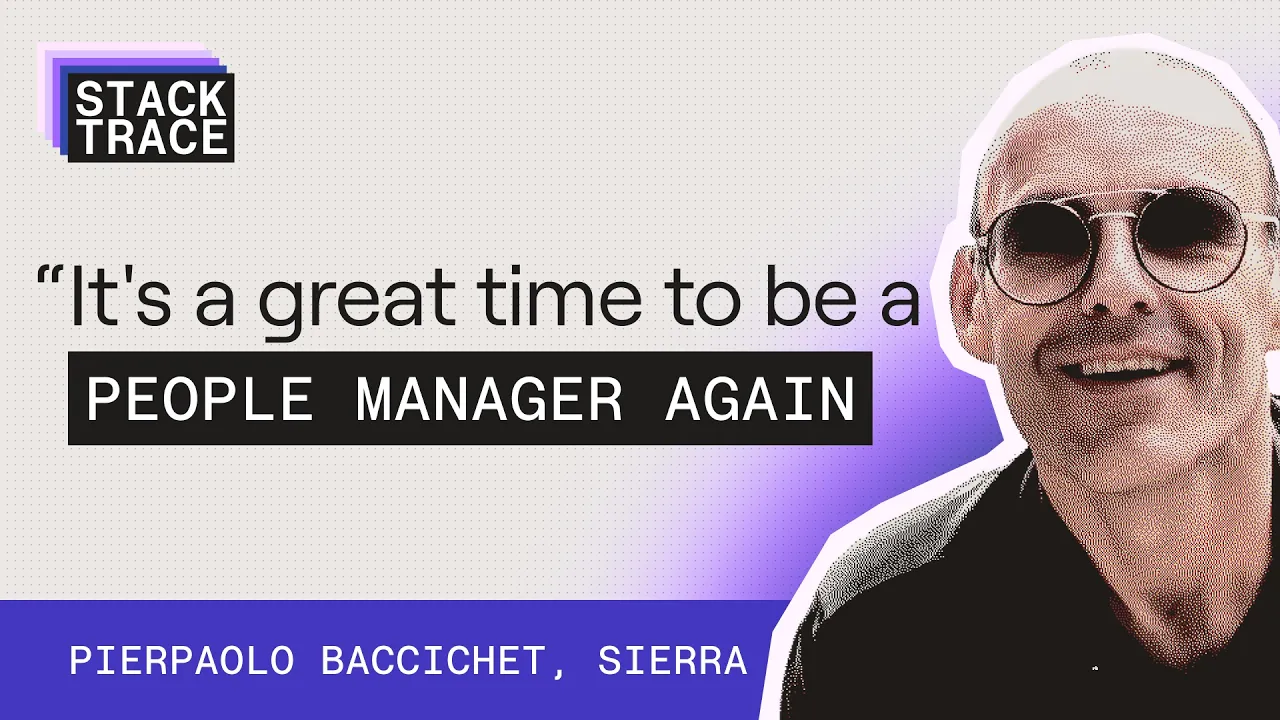
A contrarian take: it's a great time to be a people manager again. As engineers build on their own islands and drift into isolation, the manager's job is to keep them close, like a child in a cart on a short cord, not a 20-foot one.
Internal tooling now deserves production-level investment. Historically 5–10% of the engineering team at Dropbox; Pierpaolo thinks 20–30% is reasonable now, because Dev X pulls a lever on both human time and agent spend.

Pierpaolo Baccichet
Platform Engineer

Sierra
Pierpaolo is a Platform Engineer at Sierra. Prior to Sierra, he was a Senior Director of Engineering at Airtable and a Senior Principal Engineer at Dropbox. He originally received his PhD on video streaming from Italy, and was a visiting assistant professor at Stanford University.
Socials

timestamps
0:00 IC life at Sierra
1:14 Is the manager's role being reinvented?
4:01 Are we more productive, or just faster?
4:57 The 10x engineer
8:04 The fragmentation problem: ten tools for one job
9:03 What should stay human?
13:09 Is code review still a human job?
17:15 It's a great time to be a people manager again
19:14 Is engineering management a fad?
23:52 Three skills that won't get commoditized
28:27 Coordination becomes real-time
29:51 How much should you invest in internal tooling?
31:21 When token spend rivals salaries
Transcript
Pierpaolo Baccichet (0:00)
Good to see you, man. How are you?
Stephen Poletto (0:03)
I'm doing great, I'm doing great. How's the IC life treating you? For background: you were an IC and a manager at Dropbox at various times — I think you were a senior principal, the senior-most IC at the time I was there — and then you went and took on head of enterprise engineering at Airtable, and now you're over at Sierra doing IC work. How's IC life?
Pierpaolo Baccichet (0:30)
IC life is fun right now. It's a good time to be an IC — in my mind, there's a lot to build. We build in a different way, and I think it's really fun. That's why I'm doing what I'm doing. When you get to a certain scope in your job, the duties are different across roles, but the meat of what you're trying to accomplish isn't dramatically different. The day-to-day focus of what you do as a manager versus an IC is obviously different, but I don't see dramatic differences. So I'm very flexible as an individual. I like to have an impact on the company and figure out how to do it, depending on where I'm at.
Stephen Poletto (1:14)
Love it. I think the role of the manager is also being reevaluated in this AI era — there's more of an expectation that managers are hands-on with their teams, learning how these new tools work and the new way of developing. How are you seeing the shift in software engineering? Have there been any meaningful events recently that changed how you think about what it means to be building, and to be a software engineer today?
Pierpaolo Baccichet (1:47)
Well, of course something changed. Everybody talks about last year — the quality and the abilities of the underlying models — so that's clear to everybody; nothing new there. I talk with a lot of people in the industry, so some of my observations are direct and some are indirect, and it does feel like everybody is very much in a mode of trying to optimize productivity. That's fair. You hinted that the role of a manager is changing — I do think that's happening, and it feels very tactical to me. I found this pattern interesting, where we now require managers to be very hands-on. I've always been hands-on in my career, so that makes sense to me, but there's a difference between being hands-on because you're required to be as productive as everyone else on the team, versus being hands-on to be aware of how the team should operate. I think that distinction isn't clear in most people's minds. Ultimately, to me, it's about outcome. Right now the whole industry is in the "today" space, but as an individual — I like policy, reading about government, and so on — I always think about the outcome we're trying to drive. There's always going to be a human aspect in what we do: the person who uses the products we build. I find it very interesting that right now we're in the mode of outpacing each other on how much we can produce, not necessarily on the quality of the outcome we're driving for the people who use what we build. It's a very interesting time. We're in a big wave of productivity, and we'll come out of it better in the long run, but it's not clear to me that we're operating better right now. So to your question: yes, the roles are very different. As an IC, I think it's just the best time, because we're all learning something new and building things faster. There's definitely more agency for creativity — not only productivity — and that makes it fun.
Stephen Poletto (4:01)
When you read the headlines and look at the meta of token-maxxing leaderboards, lines of code, pull request volume — all these statistics about velocity and productivity — they're kind of contrived relative to the end outcome. But it sounds like you're feeling a speed-up. That firsthand experience, when you're trying to build something and you've got a clear idea of what you're building — it's faster now, right?
Pierpaolo Baccichet (4:31)
Dramatically faster, yeah.
Stephen Poletto (4:33)
Yeah, that's real. So where are the bottlenecks now? Is it about aiming and building the right things? What does that dynamic look like, now that you're able to generate code faster — where, at the beginning and the end of the process, or other parts of it, does the real human effort need to flow?
Pierpaolo Baccichet (4:57)
A couple of things come to mind. One: I don't think we're even close to the peak productivity we're going to see. I think we're getting there, and we're seeing some individuals show the way. There's always been this myth of the 10x engineer — I always felt the 10x was BS, because you're constrained by how much you can type — but now it does feel that way. The people who feel 10x have three things going for them. First, they figure out workflows. Second, they have patterns in their brain that let them keep multiple threads going in parallel. I tend to keep maybe five threads active on my screen; more than that and I start falling behind, but some people can do more. Third, either because of their knowledge or because they work in certain parts of a product line, they're able to be that fast. Other people touch core parts of a system and need to be triple careful, because there's an enormous amount of context, or the system has reliability constraints that just can't move at the same pace. So there's a confluence of factors, but cumulative productivity is trending up. We're not even close to where it's going to be in aggregate, so it still feels mostly constructive. That said, some bottlenecks have started showing up. I was listening to a podcast recently — I won't name the company, but it was one of the no-code tooling companies — and the mission is always the same: "Can I empower anybody in a company to build their own tools? Democratize software creation." We've heard that story before. But the result of that mechanism is that you end up with a ton of different tools that perform the same task, because they fit the taste of the individuals who built them.
And again, it goes back to humans. That's why I keep thinking: what keeps us humans in this environment? Humans need to collaborate. You're trying to accomplish a set of goals as a group, and if everybody has a different set of tools, you'll have a harder time accomplishing those goals. I'm now seeing that pattern pretty consistently in engineering teams: it's so easy to put together your own internal tool for task X, but so hard to coordinate that someone else solved X-prime and you just don't know about it. So you end up with X, X-prime, X-double-prime — good luck reconciling them.
Stephen Poletto (8:04)
And the result is complexity, right? Complexity, tech debt, lack of reuse — and perhaps more importantly, like you said, you don't get the network effect of people collaborating and making something better. It's just a long tail of prototype things out in the wild.
Pierpaolo Baccichet (8:20)
Let me give you a concrete example. If everybody can easily put together a capacity-planning exercise, and you have a company where 10 people make the same capacity plan, you end up with not just the wrong outcome — you end up with negative value accrued, because you'll cause confusion rather than alignment. That's an abstract example with relatively little to do with engineering, but it applies tangentially. In engineering it's the same thing: you invent alerting, you invent your own internal way to do reviews, you name it. So yeah, that's starting to become pretty visible in a lot of the conversations I have.
Stephen Poletto (9:03)
Let's talk more about what should stay human in this AI transformation. Depending on who you follow on Twitter and what you read, a lot of people draw analogies to the assembly line or automobile factories — there used to be these assembly tasks, software engineers would write code and put the pieces together, and now we have robotics and Gen AI to put the pieces together, so we can automate away a lot of these software engineering roles and jobs. You've been talking about the idea that certain parts of software engineering can become easier, but certain things need to stay human. How are you thinking about that — what should become the realm of automation and tooling, and what should stay human as we go through this transformation?
Pierpaolo Baccichet (10:05)
It's very interesting to me, and my thinking is truly evolving, because the field is evolving. But there's no scenario where you're not going to have people. Now, the number of people — everybody talks about how many jobs will be around — I don't think we necessarily need to go there. We can, if we have time. But there's no scenario where there isn't going to be a pool of people responsible for a product that's then used by another pool of people. We forget that part consistently. One of the people I follow and actually read on LinkedIn is the CEO of Linear. Recently I really like everything he posts, and it's just focusing on the outcome: the quality of the product we're producing, which is ultimately what we'll all be proud of. One pattern I see is that now everybody's moving at a faster pace, you end up with so many threads in parallel, and you end up with a more fragmented product experience. In the past we used to say you ship your org chart; now you're shipping your agents — it's way more granular and fragmented than before. So, back to your question, there must be some touch points that guarantee that outcome. I do not know who the audience of this chat is going to be, but I'm making it about outcome — I'm not being abstract about people. Of course I care about people a lot personally, but I'm framing my thinking as: what is the outcome we're trying to drive as engineers? I don't want to miss that this is all about people in my mind. But with that outcome, there are certain processes — planning, especially in this environment, is in my opinion underrated. And maybe that goes back to the Linear CEO again; there's something there.
Stephen Poletto (12:22)
Yeah, I saw he recently posted about their team generating too many disparate product ideas, and the cohesion of how they fit together was lacking. He was articulating a need to slow down and be more intentional about the end product experience, because ultimately your customers get confused if you just ship a bunch of disparate prototypes — not too dissimilar from your capacity-planning example. If you've got 10 different capacity-planning tools, you lose alignment and collaboration; if you ship 10 features that don't cohesively work together and there's no unifying vision behind them, it just becomes confusing to your customers, right?
Pierpaolo Baccichet (13:09)
A lot of this thinking started a few months ago when I kept seeing everybody saying the same thing. Now you get this giant diff that nobody reads, and of course that bothers you deeply. I started rationalizing it: objectively, these LLMs are doing a better job than most humans, including myself, at reviewing the narrow things — they're just not necessarily good yet at the taste aspects. You're missing certain parts of the context in the codebase, certain context on the business side. Fair — we still absolutely need humans. But for the actual code review, I'm getting past that point myself. I'm seeing comments that are just better than what I would write, and I find myself already relying on the automated reviewer. Recently I was at a small gathering with one of the big companies, and one company that works in a heavily regulated industry was sharing their internal story on how they do development for bug fixes — from a Slack message all the way to production. They still attribute reviews to humans, but they're working with regulators to get the stamp that automated reviews will be better, and I buy that personally. So I used to think reviews were a touch point for humans, and I'm turning around on that one. I feel like the need for coordination is on the planning, the context sharing, and ultimately the aspects that help the team drive and maintain the outcome. I don't think there's going to be a one-size-fits-all. But what I'd encourage engineering leaders to do is think about the fact that you're going to still have to work with people two years from now.
There will be companies where reviews are automated. There will be companies where you rely on reviews but planning doesn't matter — you just iterate super quickly, and that's okay for your product. I don't know what it is, but I tend to think planning is where there should be more time spent nowadays. A lot of people start talking about spending more time planning, creating your plan, but they always think about their agent — they keep talking about their agent. The counterexamples I shared earlier — the company-level vision is often lacking nowadays. That level of coordination is lacking. Part of it is the pace. Another bit of context worth calling out: the pace nowadays is ridiculously different from what we experienced up to 2023. I was at a company where the pace just felt different, and now all the companies that came up at the end of the pandemic are all in-office, all high-intensity. Part of that is cultural, which is good — it's a counter-reaction to what happened during the pandemic. But the reality is that this new technology is opening the market for everybody, and everybody's trying to grab it. There are multiple compounding factors contributing to this intensity we're seeing.
Stephen Poletto (16:37)
There's also the fact that you can create delegated workloads that run asynchronously while you sleep, but eventually they get blocked and need your input, and you might be juggling five different threads like you were talking about. So there's a sense in which individual contributors are now managing a fleet of agents doing work — and, I mean, you've been a manager: there's constant interrupts and escalations and things to be dealt with at all times. That pulls you toward an always-on mode of operation. So that's another factor contributing to the intensity, I'm sure.
Pierpaolo Baccichet (17:15)
Can I give you a contrarian opinion on the pattern for managers?
Stephen Poletto (17:19)
Yeah.
Pierpaolo Baccichet (17:20)
I truly believe that now it's a great opportunity for managers to be people managers again. It may be early in the cycle, but I'm starting to see the pattern where people lose track of each other, because it's so much easier to build something on your little island. Then you get in a meeting three weeks later and somebody brings up, "Okay, what the heck happened there? What is this thing that popped up in our area that nobody knew about?" The second aspect is, from a human perspective, that pattern leads to isolation. It feels to me like some of those 10x engineers, if they're not careful — or not coached or helped — they run much further ahead; there's room to run away. One framework I liked in the past — I think it was actually one at Dropbox — ran it in an interesting way. I tend to think about people who go ahead and show the way for the team; I call them "pullers." They go ahead and bring the team along. Then you have people behind. I tend to be a bit more the second archetype — I'll try to evangelize a direction, maybe show some prototypes, to push the team forward. There's a sport analogy there, but the analogy in my mind the other day was: when you have a little one in the house and you carry them along — you drag them in a little cart — you never use a cart with a 20-foot cord. It needs to always be close, because you want to make sure they come along with you. That's the role of managers right now. The over-indexing on productivity — which is understandable — comes with that risk, and I wanted to call it out.
Stephen Poletto (19:14)
I like it, because I'm sure you've seen all the commentary about the role of the manager out there. Will Larson wrote a post last summer or fall — "good engineering management is a fad" — and he talked about how the people-centric engineering management of the late aughts and early 2010s is something we'll look back on as a phase, and that management will become people who lead through doing, setting the path forward and being more hands-on in the way we're describing. But I like the counter-narrative: coordination, alignment, and ensuring we're all rowing together in one direction is still a critical role to play in an organization. Otherwise you end up with a lot of disparate solutions that don't ladder up into something bigger. The whole point of a team and a company is to put two and two together and get five — the whole is greater than the sum of the parts. So I like it; we need more of that counter-voice on what good management is.
Pierpaolo Baccichet (20:28)
I understand the point of view. In whatever scenario, there's going to be a certain number of people who have jobs. Whatever your guess or my guess is doesn't really matter. Those people will have their needs, just like they always have in any company. They'll tell you, "Oh, we don't have a leveling framework" — but they still do, one way or another, and people will always want to grow and get better at what they do. The job of the manager doesn't go away. We've been in places where we've seen TLM (tech-lead-manager) roles — I personally never bought it. I've been a TLM myself; it feels unfair and unjust in a variety of ways. Maybe I'm very European in this regard, but it feels to me like we're not keeping enough focus on the long-term outcome for the people we work with. That's my only point here.
Stephen Poletto (21:18)
Yeah, good point. So you said something earlier about the role of the manager being hands-on enough to understand what's going on, and things are changing like crazy. What do you see successful managers doing in this era? How are they staying informed of the latest and greatest with AI-driven development, and ultimately supporting people — being aware, not just operating the old management playbook of five years ago, because things are so different now?
Pierpaolo Baccichet (21:54)
Again, it works differently at different companies, but ultimately there are two archetypes. The first is people who also build — they contribute to the feature set, which is pretty common right now. It depends on the area, but if you're at a company with decent abstractions and some internal investment in developer productivity, it's fairly viable for a manager to contribute while still doing the rest of the work. The second archetype — for instance, at Airtable, I was doing this — is fairly hands-off but very aware of what's going on. I was looking at all the code reviews because of the volume of reviews. I don't know if I'd be able to do that right now in a manager role, because it's just a lot. So in the second archetype, you're basically aware of everything that hits the codebase, and why the codebase is centered a certain way — why is the team adopting tool A versus tool B, what was the reasoning? Good managers have always been aware of that. But I've seen a lot of managers — maybe that's what Will was referring to in that post — lose track of it.
Stephen Poletto (23:23)
Too hands-off from the technology.
Pierpaolo Baccichet (23:26)
Yeah, yeah.
Stephen Poletto (23:27)
Kind of pure people management, too hands-off from the technology.
Pierpaolo Baccichet (23:31)
Yeah. And to be clear, I'm not advocating for pure people managers. It's good — you need to be aware of what's going on in your team and how the team is changing, to be able to help the team. But I tend to think about the outcome for the business and the long-term health of the team. So you still need to do that. I'm not playing down that part.
Stephen Poletto (23:52)
No, I hear you — talking about setting direction and being a curatorial steward, helping everyone row in the same direction. Those roles are vital. Okay, we've talked about managers; let's talk about engineers a bit too. What will it mean to be a great engineer in 2028? The role is changing, the requirements are changing. What do you think are critical skills for engineers to be successful over the next couple of years? I know I'm not asking you to have a crystal ball — these models are going to keep getting better, the tooling is going to keep getting better, things will continue to change — but as you think about advice you give to the more junior engineers you're working with, and for yourself, what skills do you think are important to keep honing? Let's say a mid-level or senior engineer: they're experienced, they've built and shipped software, they've led features in the past, but is AI coming for their jobs? How do they stay sharp, and what's going to make them valuable two or three years from now?
Pierpaolo Baccichet (25:04)
As an immigrant myself, this is very close to heart. The way I reason about it: if you put your skill set on an axis, anything in the middle is going to be commoditized. So code is getting fairly commoditized. What's not getting commoditized is understanding whether there are edge cases the LLM didn't catch — specifically because of the codebase you're in, specifically because of the performance you want. Those kinds of skill sets aren't getting there. The other aspect is business understanding. So if you put it as a sphere instead of an axis, three things come to mind. One is the ability to debug. That's still there. I hear plenty of stories where people have outages, and you have Slack channels where everybody just copy-pastes the LLM's diagnosis of the day, comes up with wild theories, and then eventually realizes, "Oh crap, it was something we didn't think about at all," and one engineer finds it. I've seen it, and I've heard the stories multiple times already, and it's just going to get worse in the short term. So the debugging skill set — which hides systems knowledge underneath it — I think for people coming out of school, their systems knowledge is still really valuable. Just having an understanding of the good old Jeff Dean numbers: do I know where the bottlenecks are, what matters and what doesn't? That's still absolutely valuable.
The second aspect is business context. At any scope, it goes back to understanding the business needs; otherwise you end up shipping the output of an agent rather than something functional to the product you're trying to serve.
The third aspect is the ability to collaborate. You touched on being part of an old-school factory — blue-collar versus white-collar work. I tend to think about engineering as an art form; craft is the thing that resonates with me. It's an ensemble of people. If you think about it — I play the violin, you play another instrument, but we try to create something together. That aspect needs to still be there to be effective. It's always been there. I feel like we're missing the conductors right now: the masters are either coding or playing an instrument themselves — that's what they're asked to do — so they're not directing the orchestra, or they're not paying enough attention. So those three aspects — debugging, the ability to collaborate, and business understanding — I name those three because, if you reason about the skill set as a sphere, they're on the outer edges. The ability to code, sadly for old-school people like me, is getting commoditized. I'm doing some Terraform now; I'm delegating heavily. I review when it gets to security, but I don't think I'll know Terraform anytime soon.
Stephen Poletto (28:27)
It's a good metaphor, because in the historical world of software development, the coding phase took so long that you could have slower coordination cycles. You could do bi-weekly sprint planning, maybe daily stand-ups, or stand-ups a couple of times a week — there was enough latency on the line that you could do these slow-moving cycles. Now, with how fast everything can move, it's almost more real-time, as a conductor, to say, "Oh, there's a coordination lapse here, let's pull this agent or this team closer in." Don't let them go too far off — that point of pulling the team in the right direction. So it's becoming a more real-time role in a lot of ways, which is exciting, because it means you can test hypotheses faster, speed up your cycles, and bring ideas to life faster. So, Pier, this has been a really fun conversation. Is there anything you'd want to share with our audience — engineering leaders, senior ICs? Maybe any interesting wins recently, techniques you've found to work well? Maybe some plan-mode secrets or other things you've found good traction with that others might benefit from?
Pierpaolo Baccichet (29:51)
I'm not a master of productivity, because of the areas I tend to deal with at my current employer — it's pretty deep in the stack, so I'm not optimizing for my own productivity. One thing I've been thinking about, especially for engineering leaders, is how much proactive investment — percentage-wise — your team should allocate to internal tooling and unlocking acceleration. Historically, at Dropbox, we allocated between 5 and 10% of the engineering team. I think it's not unreasonable to see these investments going to 20–30% in the short term, and that's where I'd part ways with the old approach.
Stephen Poletto (30:41)
Yeah.
Pierpaolo Baccichet (30:42)
It's going to yield more value than in the past. In the past, internal tooling was always something people reluctantly invested in when they were called out to do it. Now it's absolutely obvious that — without sharing individual companies' trade secrets — there's a ton of value in making sure your agents have access to the right information. Everybody talks about giving them more agency, which can be questionable, but access to the information you have access to as a human is valuable, and that's not easy to do safely, depending on the environment you're in.
Stephen Poletto (31:21)
That's a great point, because now the impediments to productivity in your developer workflow are impacting not just your labor — your human time — they're also impacting your agent spend, your token spend. We're seeing token spend grow into double-digit percentages of salary. At the extremes, people are talking about 50 up to 100% of salary. An Nvidia VP said yesterday that his team is spending more on tokens than on salaries now, which is crazy.
Pierpaolo Baccichet (31:51)
That is what they want — they have an incentive for that to happen, for sure.
Stephen Poletto (31:53)
Yeah, but that's an economic argument for why your Dev X matters so much more, because it now has a lever on both human time and agent spend. So we'll leave the audience with that. Thank you so much for spending time with us, Pier. This was fun.
Pierpaolo Baccichet (32:12)
Thank you. It was fun indeed.


Let's talk about where your AI program is.


platform
Resources
© 2026 Attuned Inc.


